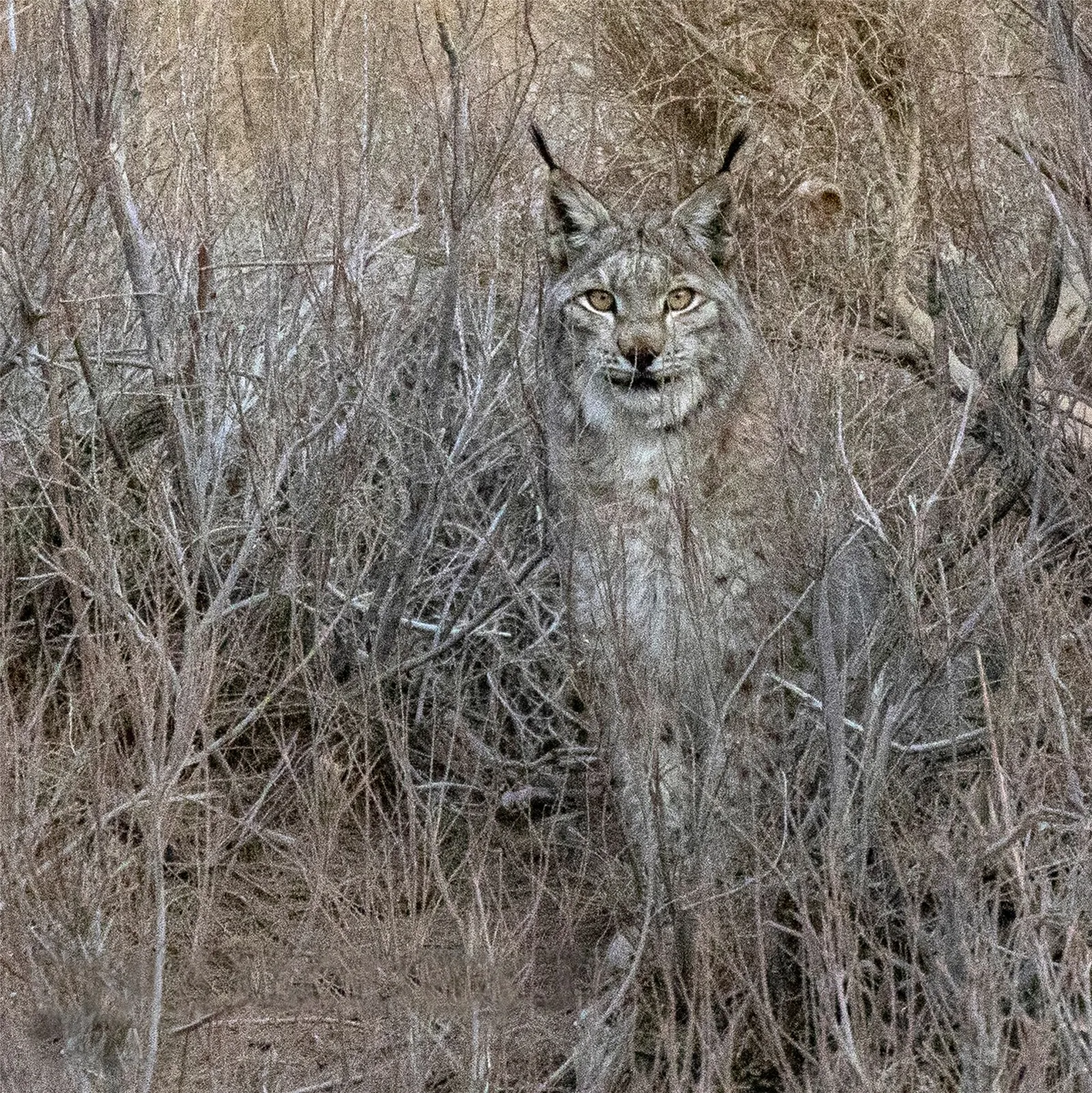
The Eurasian Lynx is a medium-sized wild cat found across Europe and Asia, including Mongolia. In Mongolia, it occurs in relatively small and scattered populations. It can live in mountain forests, rocky areas, bushy slopes, valleys between mountains, and some desert-mountain habitats.
The Eurasian Lynx has a strong body, long legs, large paws, a short tail, and pointed ears with black hair tufts at the tips. These ear tufts are one of the easiest ways to recognise a lynx. It also has cheek ruffs, which are longer hairs on the sides of the face.
Its coat colour can vary from greyish-brown to yellowish-brown or reddish-brown. The body is often marked with dark spots or stripes. The belly, throat, and inner legs are usually lighter or whitish. Its short tail has a black tip, which is another important identifying feature.
The Eurasian Lynx is a solitary and secretive animal. It usually avoids people and is difficult to see in the wild. It is most active at night, early morning, and evening. During the day, it often rests in hidden places such as rocky shelters, thick vegetation, or quiet forested areas.
This animal is a skilled hunter. It uses sharp eyesight, excellent hearing, stealth, and patience to catch prey. The lynx usually does not chase prey for a long distance. Instead, it quietly stalks or waits, then suddenly jumps and attacks.
Its main food includes hares, pikas, rodents, birds, and small to medium-sized hoofed animals. In some areas, it may also hunt young deer, musk deer, wild goats, or other small wild animals, depending on what prey is available.
The Eurasian Lynx plays an important role in the ecosystem. As a predator, it helps control populations of small mammals and other prey animals. This helps maintain the natural balance of forest, mountain, and steppe ecosystems.
In Mongolia’s Gobi Altai region, some lynx are locally known as Gobi Lynx. These lynx are adapted to rocky hilltops, bushy woodlands, mountain valleys, and oasis areas in the dry Gobi mountain landscape.
The Eurasian Lynx is well adapted to cold and rugged environments. Its large paws help it walk on snow and rough ground. Its thick winter fur protects it from cold weather. Its spotted coat helps it blend into forests, rocks, and dry mountain landscapes.
Although the Eurasian Lynx is not globally considered highly endangered, it still faces threats in some regions. These threats include habitat loss, habitat fragmentation, illegal hunting, decline of prey animals, and conflict with people when livestock are attacked.
Protecting the Eurasian Lynx is important because it is one of Mongolia’s special wild cats. Conserving this species also helps protect the wider mountain, forest, and desert-steppe ecosystems where many other wild animals live.
Image gallery