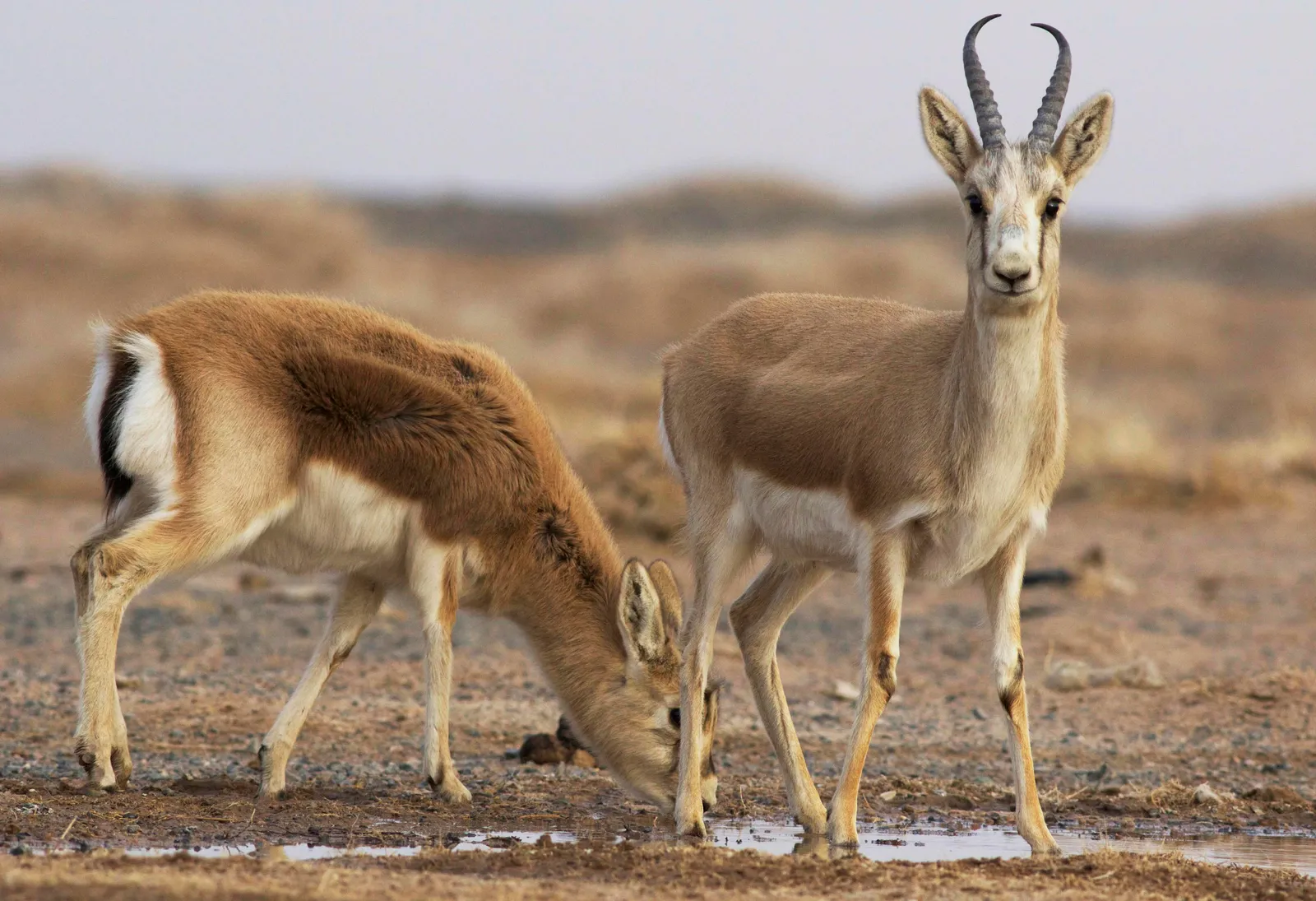
Name: Goitered Gazelle / Black-tailed Gazelle
Scientific name: Gazella subgutturosa
Mongolian name: Хар сүүлт зээр
Other English names: Black-tailed Gazelle, Persian Gazelle
The Goitered Gazelle, also known as the Black-tailed Gazelle, is a medium-sized wild antelope that lives in dry steppe, semi-desert, and desert habitats. In Mongolia, it is found mainly in the Gobi and desert-steppe regions.
The Mongolian name Хар сүүлт зээр means “black-tailed gazelle.” This name comes from the animal’s clearly visible dark or black tail. The English name “Goitered Gazelle” comes from the male’s enlarged throat area, which becomes more noticeable during the breeding season.
The Goitered Gazelle has a slim body, long legs, a short tail, and a graceful appearance. Its coat is usually sandy brown, pale yellowish-brown, or light fawn, which helps it blend into dry grassland and desert landscapes. The belly, inner legs, and rump are usually white or very pale.
Males usually have dark, curved, ringed horns. Females are often hornless or may have much smaller horns. During the mating season, males can develop a swollen-looking throat, which is one of the special features of this species.
The black tail is an important identifying feature. When the gazelle runs, the dark tail can be easily seen against the pale body and white rump. This helps distinguish it from some other gazelles and steppe antelopes.
The Goitered Gazelle is very fast and alert. It uses speed, open landscapes, and sharp senses to escape predators. It can run quickly across flat plains, gravel areas, and dry valleys.
This species usually feeds on grasses, herbs, leaves, shoots, and desert plants. It is well adapted to dry environments and can survive in areas where vegetation is sparse. During different seasons, it may move across large areas to find food, water, and safer habitat.
Goitered Gazelles may live alone, in small groups, or in larger herds depending on the season, food availability, and breeding period. In open landscapes, group living can help them detect danger more easily.
The Goitered Gazelle plays an important role in the Gobi and desert-steppe ecosystem. By grazing and moving across large areas, it contributes to the natural balance of dryland habitats. It is also an important prey species for predators such as wolves and large birds of prey.
Today, the Goitered Gazelle is considered a vulnerable species. It faces threats from illegal hunting, habitat loss, mining, roads, railways, fencing, livestock competition, and disturbance around water and grazing areas. Fences and roads can block its natural movement and reduce access to important habitats.
Protecting the Goitered Gazelle is important because it is one of the special wild animals of the Mongolian Gobi. Conservation of this species also helps protect the wider desert-steppe ecosystem where many other rare animals live.
Image gallery