This place has beatiful stones
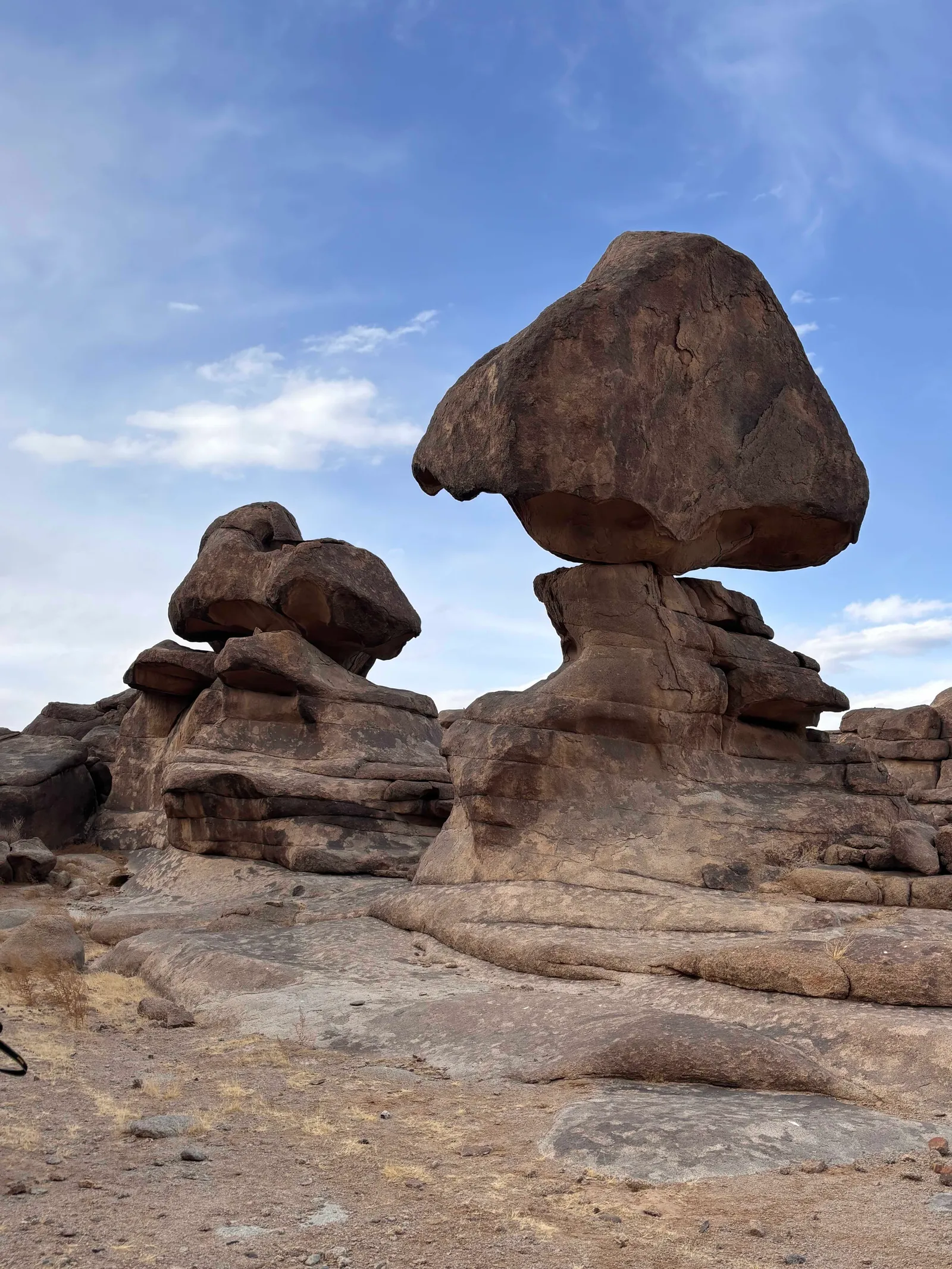


The Shar Tsav paleontological site is located on the border of Manlai and Khanbogd soums in Umnugovi province, about 650 km south of Ulaanbaatar and 80 km from the nearest settlement, Khanbogd soum. Administratively, it falls within the Uguumur bagh of Manlai soum, situated 108 km directly south of the soum centre.
In 1995, over 13,000 dinosaur tracks were discovered at this site, with detailed studies conducted in 1996 and 2001. The majority of these tracks belonged to theropod dinosaurs, with sizes ranging from 6 to 70 cm in length. Notably, nine parallel trackways, each made up of distinct footprints of various sizes and shapes, revealed unique characteristics, including the distance between steps, direction, and formation conditions. These trackways offer significant research value.
The site was designated as a state-protected historical and cultural monument by the Mongolian government in 2013 (Resolution No. 414), establishing a 408-hectare protected zone. This protection was reaffirmed by another government resolution on January 8, 2020 (Resolution No. 13). Shar Tsav dates back to the Late Cretaceous40 period, specifically the Bayan Shiree formation (K2bs). It was first discovered on July 31, 1995, by the Mongolian-Japanese joint paleontological expedition led by Kh. Tsogtbaatar, about 10 km northeast of Baishin Tsav in Khanbogd soum. Earlier paleontological and geological studies of Shar Tsav were conducted in the 1980s by the Mongolian-Russian joint expedition led by Ivakhnenko and Kurzanov (1982), who identified two types of dinosaurs at this site.

Ergelyn Dzo is a paleontological and natural heritage site located in Khatanbulag soum, Dornogovi province. It is known for its unique Gobi escarpment, colourful sedimentary layers and ancient fossil remains.
The site contains fossils of ancient mammals, fish, turtles and lizards from more than 30 million years ago. It became internationally known through early paleontological research, including the Central Asiatic Expedition led by Roy Chapman Andrews in the 1920s.
Ergelyn Dzo is important for understanding ancient life and past environments in the Gobi region. Today, it is protected as a natural reserve and as an immovable historical and cultural heritage site of Mongolia.


Ereet Monastery is a historic monastery ruin located in Khanbogd soum, Umnugovi province. It is connected with Noyon Khutagt Danzanravjaa and the Galba monastery complex. Ereet Monastery is often mentioned as one of the three historic monasteries in the Galba Mountain area, together with Demchog Monastery and Tsagaan Tolgoi Monastery.
The monastery is located near Demchog Monastery. Historical and local sources describe Ereet Monastery as an important religious and cultural site where monks gathered for Buddhist teachings and ceremonies. Noyon Khutagt Danzanravjaa is also said to have studied and taught Buddhist scriptures at this monastery.
Today, Ereet Monastery remains as a monastery ruin and is valued as part of Mongolia’s historical, religious and cultural heritage. The site is important for understanding the spiritual history of Khanbogd soum and the Galba Gobi region.

Known locally as Khavirgiin Buuts or Khavirgiin Dzo, this area became recognized as a paleontological site on May 1, 2016, when paleontologist B. Mainbayar and colleagues from the Institute of Paleontology discovered exceptionally well-preserved dinosaur tracks. During field research, they identified four massive tracks belonging to a giant sauropod, seven consecutive theropod tracks, and a potential series of ornithopod tracks. Subsequently, in January 2020, the site was officially designated as a provincially protected paleontological heritage area. Khavirgiin Dzo is considered a site of great significance for dinosaur paleobiological research.
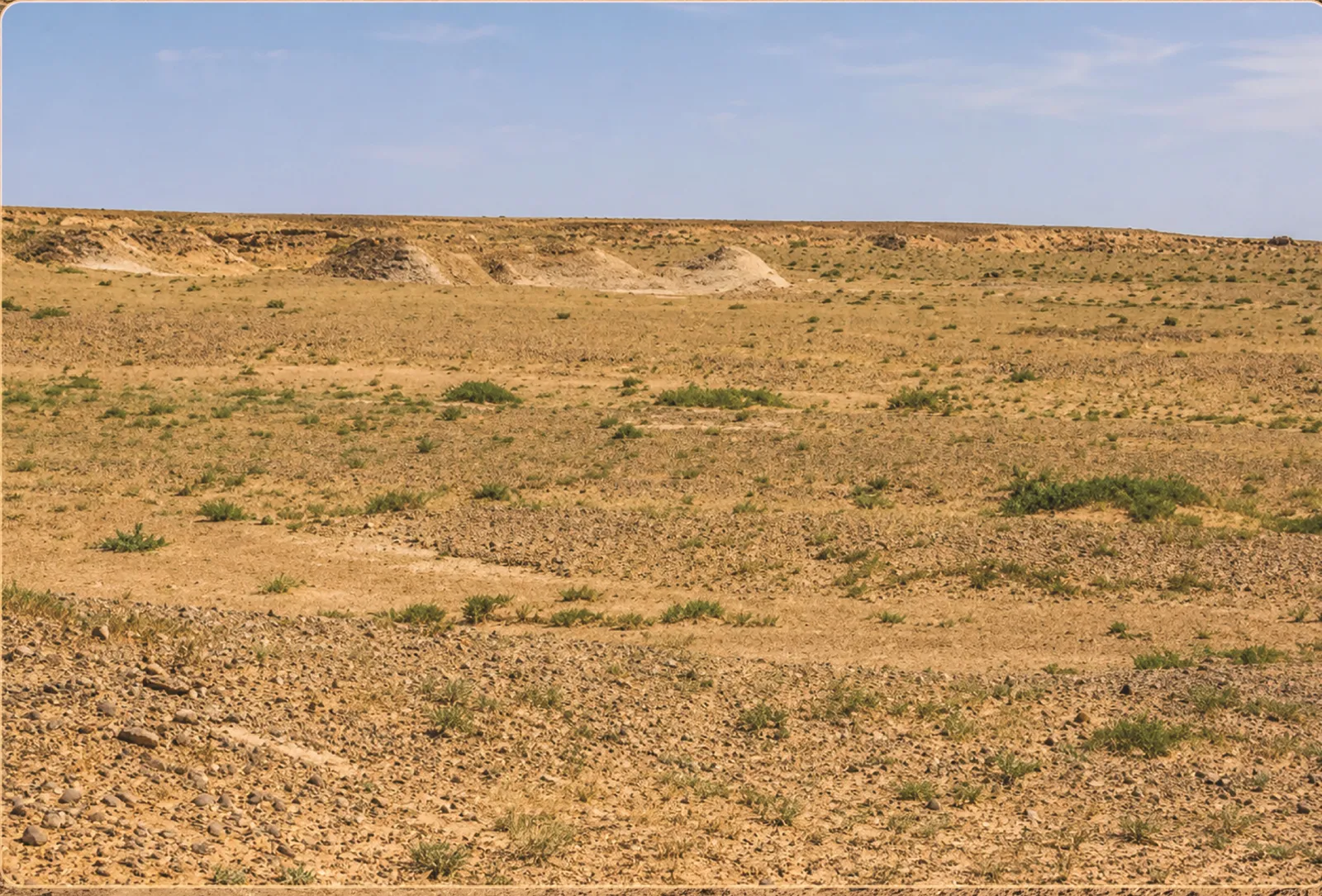
Located at an elevation of 904 meters above sea level, this fossil site spans approximately 0.8 by 1.2 kilometres in latitude and longitude. It lies about 2.9 kilometres southwest of the Baishin Tsav fossil site.
The fossil-bearing layers are generally exposed along a ridge facing south. These strata belong to the same formation as Baishin Tsav (Kurochkin and Barsbold, 2000), and well-preserved hadrosauroid fossils, including articulated cervical vertebrae, cranial remains, and tail segments, have been discovered here.
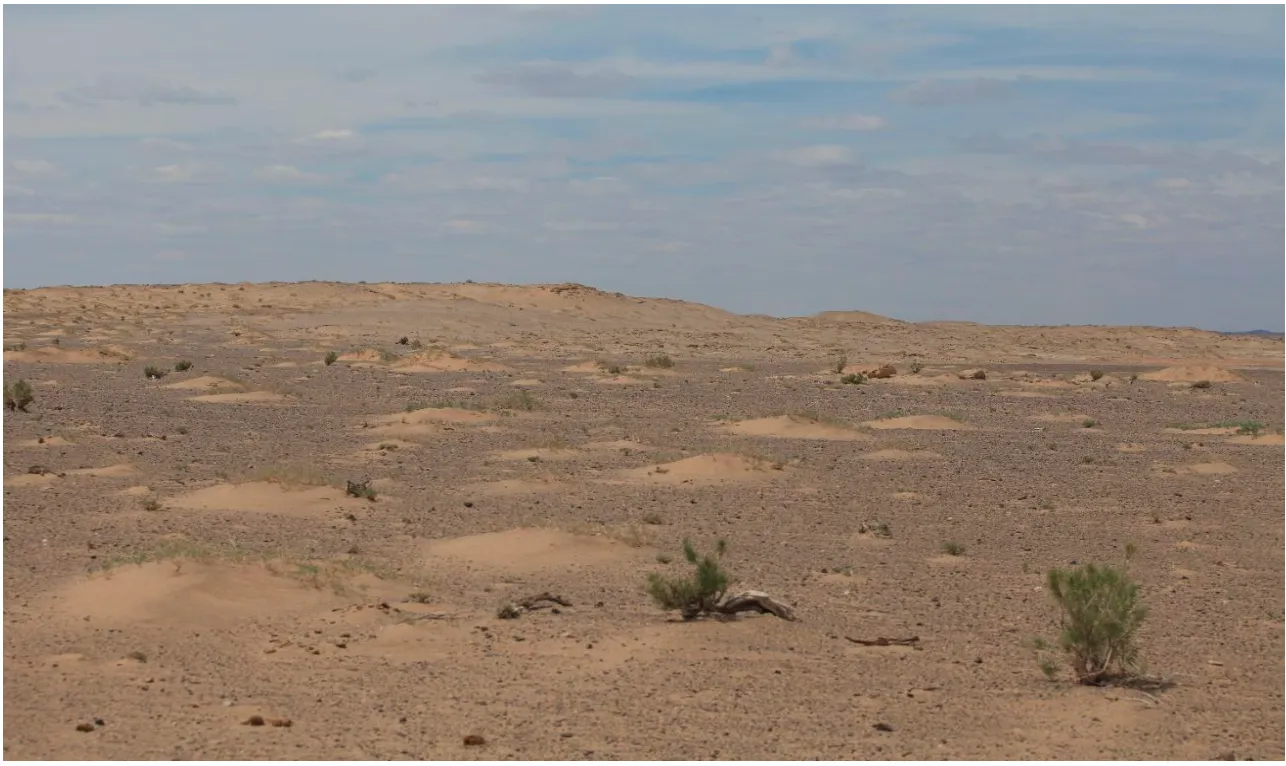
This fossil site is located in the southwestern part of the Baishin Tsav Basin, approximately 2 km southwest of Urelbe Khudag. The first scientific publication about this site was released in 1974 by Russian scientists V.F. Shuvalov and T.V. Nikolaeva. It is designated as a protected historical and cultural heritage site under the Mongolian Government resolutions issued on May 14, 2008 (No. 175) and January 8, 2020 (No. 13). Located in the Khankhongor District of Umnugovi Province, the Urelbe Khudag fossil site dates back to the Late Cretaceous period, specifically the Bayanshiree Formation (K2bs).

Geological and paleontological studies of this fossil site were conducted in the 1970s by a joint Mongolian-Russian expedition, classifying it under the Bayanshiree Formation (Shuvalov and Chkhikvadze, 1975). Elevation above sea level: 905 meters. Coverage area: 1.8 x 2.1 km.
This site consists of numerous small gullies that form cliffs and minor outcrops in a vast, flat plain. It is renowned for its abundance of dinosaur fossils. The site is divided into five subsections (BTs-I, II, III, IV, and V). Baishin Tsav-I extends from east to west, forming a southern-facing escarpment running west to east. Bayshin Tsav II and V are outcrops extending southward from the eastern end of Baishin Tsav-I. Baishin Tsav III and IV are lower escarpments and isolated small outcrops located southwest of the above-mentioned sections. These strata are rich in vertebrate fossil remains.
Recent excavations have uncovered numerous complete skeletons, fossil clusters, and isolated bones of hadrosauroids (Ornithopoda, Dinosauria). Additionally, fossils of dromaeosaurids, ornithomimids, and therizinosaurs have been found here. The western part of Baishin Tsav-I is notable for the discovery of dinosaur eggshells (Elongatoolithid type). The site is listed as an immovable historical and cultural heritage under state protection, officially designated by Mongolian Government Resolutions dated May 14, 2008 (No. 175) and January 8, 2020 (No. 13).
Located in the territory of Khanbogd soum, Umnugovi province, Baishin Tsav is dated to the Late Cretaceous, specifically the Bayanshiree age (K2bs).

Located approximately 15 km northeast of Baishin Tsav, this fossil site is considered to belong to the lower part of the Bayanshiree Formation. The visible thickness of the strata in this area is around 45 meters, and it is notable for the discovery of a highly interesting new species of turtle, Anosteira shuwalovi. The age of the Amtgai strata has been determined as Late Cenomanian–Turonian, based on freshwater mollusk assemblages and the turtle fossils, corresponding to the lower part of the Bayanshiree Formation in the international geochronological scale.
The site is listed as an immovable historical and cultural heritage under state protection, officially designated by Mongolian Government Resolutions dated May 14, 2008 (No. 175) and January 8, 2020 (No. 13). The Amtgai paleontological site is located in the border area between Khanbogd and Manlai soums of Umnugovi province and dates to the Late Cretaceous, specifically the Bayanshiree age (K2bs).